
GAO Releases ISAM Tech Assessment
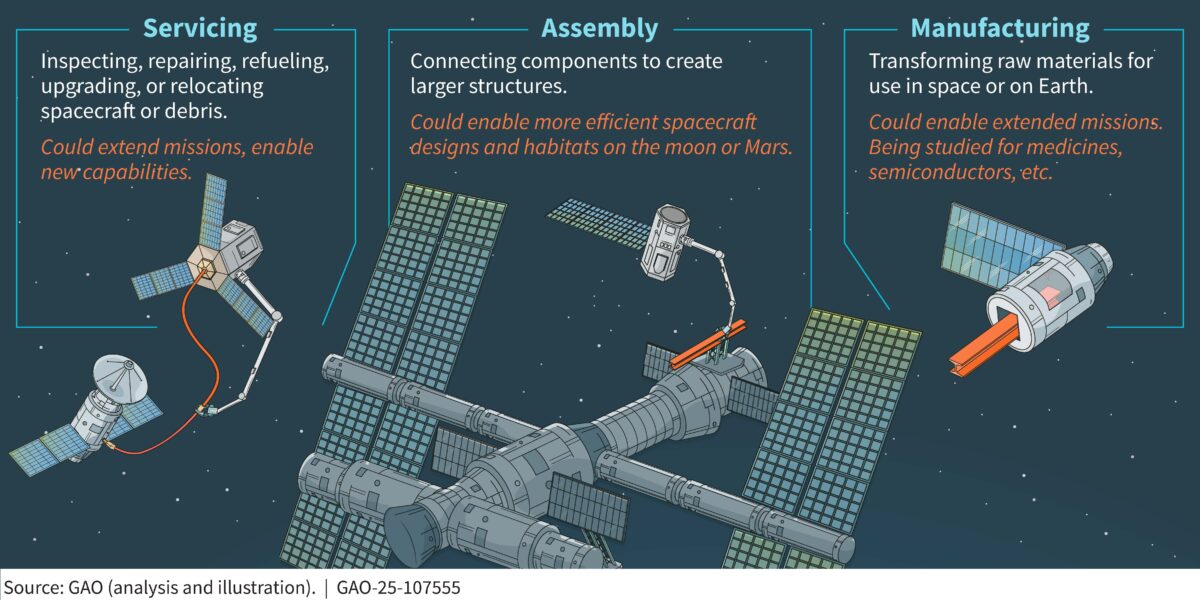
On July 10th, 2025, the Government Accountability Office (GAO) released a report entitled In-Space Servicing, Assembly, and Manufacturing: Benefits, Challenges, and Policy Options.
This new document serves as the latest validation that ISAM capabilities can and will provide a tremendous value in future space architectures and does so with a sober acknowledgement of the difficulties that have yet to be overcome.
Per the report:
ISAM could extend the lives of satellites, improve cost effectiveness of space activities, enable greater mobility, facilitate removal of space debris, enable much larger space telescopes, and facilitate construction of other very large structures in space, on the moon, or on other planets. However, the development of ISAM faces various challenges, and its potential benefits have not been fully weighed against the costs.
After conducting a thorough review and providing a thoughtful, 53-page analysis of the state of ISAM, the GAO formally weighed in to provide options for Congressional and Executive Branch actions to advance ISAM.
Many of the suggested policy options put forward by GAO (as the GAO acknowledges) are already underway within various sectors of the domestic aerospace ecosystem.
We at COSMIC are honored to have been singled out by the GAO as the preeminent partner for federal ISAM coordination moving forward.
More importantly, we look forward to continuing to work with all our members spanning government, industry, and academia to ensure that domestic capacity fully actualizes the advantages that ISAM adoption can have to advance a safe, scalable, and sustainable space ecosystem under American leadership.
Below are the five policy options that the GAO have put forward as well as our own commentary on the efforts that COSMIC is already doing to advance the outlined objectives.
You can find the full GAO two page summary here and the full 53-page report here.
Policy Option One: Maintain Status Quo
- Potential implementation approach: Sustain current efforts to address challenges to ISAM development and use. This option could include continuing efforts by industry, the National Aeronautics and Space Administration, and the Department of Defense to demonstrate servicing capabilities, standards development work by the Consortium for Execution of Rendezvous and Servicing Operations, regulatory actions, and coordination activities of the Consortium for Space Mobility and ISAM Capabilities.
COSMIC is grateful to be acknowledged in this recommendation by the GAO and appreciative of their call for the continued efforts of the Consortium.
Policy Option Two: Evaluate, and Potentially Promote, Serviceability
- A federal agency, federally funded research and development center, a nonprofit organization, or another trusted entity could conduct a series of economic studies, including cost-benefit assessments, to identify which satellites would benefit from being designed for servicing.
- Government and private satellite operators and manufacturers could update programmatic processes that might be inhibiting the adoption of satellites designed for servicing.
- Government and private satellite operators and manufacturers could require their satellites to be designed for servicing.
- Congress or government regulators could require certain categories of satellites to be designed for servicing as part of U.S. licensing requirements.
- Government agencies could require some or all of their satellites and those of their contractors to be designed for servicing
COSMIC members are currently engaged in numerous efforts and discussions that could serve as the foundation for the decisions that are called in Option Two regarding action on serviceability requirements.
Policy Option Three: Support Technology Development and Testing
- The ISAM community (including government, industry, and academia) could make on-the-ground test facilities more accessible and, if necessary, create new test facilities.
- Government agencies and private companies could support the creation of and access to an in-space test bed for ISAM technologies.
- Government agencies and private companies could support a series of in-space missions to demonstrate life extension, refueling, debris removal, or other capabilities.
COSMIC members are leading efforts that can serve to advance Option Three, including but not limited to existing products on gap-analysis and as the GAO noted, a public and private test capability inventory. The COSMIC Demonstration Infrastructure Focus Area is well positioned to support policymakers if called upon.
Policy Option Four: Develop or Clarify Regulations and Standards
- Government regulators could clarify ISAM regulations and licensing processes, including for access to radio spectrum.
- The Departments of State and Commerce could continue reevaluating export controls on ISAM technologies.
- Congress could designate a centralized licensing authority for all commercial space activities.
- Government agencies, nonprofit organizations, standards organizations, and private industry could develop and promulgate standards.
- Government satellite manufacturers and operators could specify what standard(s) they will accept.
COSMIC members have crafted a foundation that could be used by the relevant agencies in their consideration of any regulatory changes. Through efforts by the COSMIC Policy & Regulation Focus Area, leaders across the domestic space enterprise have engaged in panel discussions, seminars, and workshops on topics spanning spectrum allocation, export controls, international frameworks, and more. Lessons from these activities are being collected for use by the community and others.
Policy Option Five: Designate a Government Champion
- Congress or the White House could designate a government champion to support ISAM development and coordinate with the Consortium for Space Mobility and ISAM Capabilities.
COSMIC is grateful to be acknowledged in this recommendation by the GAO and appreciative of their call for greater attention and coordination by the federal government. We stand ready, willing, and able to continue to be an effective, trusted partner to whichever government champion would be designated should Option Five be implemented.
If you are interested in learning more about ISAM and COSMIC, watch our 13-minute documentary COSMIC Crossroads: Building the Space Superhighway, which explores how America is leading efforts on In-space Servicing, Assembly, and Manufacturing (ISAM) — and how these technologies are being developed by organizations across the nation to maintain U.S leadership in space.
Featuring experts from NASA, the U.S. Space Force, the aerospace industry, and academia, viewers will learn how ISAM will extend the life of satellites, reduce space debris, and build a future where space is safe, scalable, and sustainable.
Learn more at cosmicspace.org/crossroads/