
COSMIC Report Identifies Opportunities, Gaps and Needs for Geostationary Refueling
Report Recommends “Persistent Platform” for Testing Refueling Capabilities On-orbit
The Consortium for Space Mobility and ISAM Capabilities (COSMIC) has published an analysis of the current and future prospects of on-orbit refueling in geostationary orbit (GEO), finding that “significant work remains” to make this key use case “reliable and routine” for national security, civil and commercial space to leverage in-space servicing, assembly, and manufacturing (ISAM) capabilities.
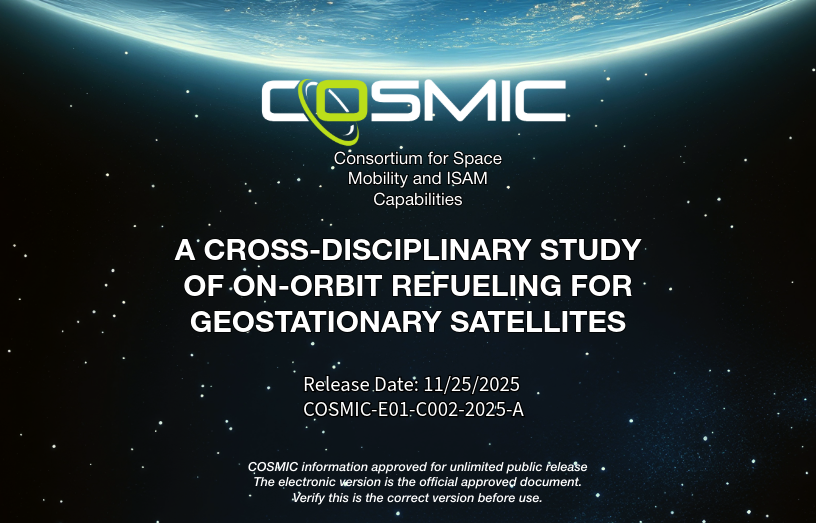
The report—A Cross-disciplinary Study of On-orbit Refueling for Geostationary Satellites—documents existing use cases based on currently available and mature technologies, along with potential GEO refueling use cases that are not yet mature and recommendations for bridging those maturity gaps.
“Satellite refueling offers the benefits of operational, financial and performance flexibility. For many space operators, maneuverability is the mission, and we want future satellites to maneuver as needed without the concern that doing so will shorten their lifetime. The COSMIC community wants to see a robust economy emerge that builds off many already-proven concepts to provide refueling in GEO safely, reliably and routinely,” said COSMIC Executive Director Greg Richardson.
The report represents the consensus of an integrated project team involving members from COSMIC’s Government, Industry, and Academia caucuses supporting four of its five focus areas. Primary gaps, the report finds, include the capability to consistently and rapidly perform in-space testing of fluid transfer and storage, as well as in-space experience with end-to-end systems for rendezvous and proximity operations and docking.
Among the report’s key recommendations is the development and deployment of a “persistent platform” testbed for on-orbit demonstrations to advance critical GEO refueling capabilities. “Such a testbed could support a wide range of experiments,” the report states. “It could also provide embedded capabilities (power, robotics, computing, and communications) that reduce the per-mission cost and risk by avoiding the need for dedicated missions for each technology demonstration. The persistent platform could potentially be deployed in less commercially valuable orbits (e.g., graveyard orbits) to mitigate risks to operational spacecraft.”
Other noteworthy findings, gaps and recommendations in the report include the following:
- Technology Maturity: while many technologies essential to perform GEO refueling are well-developed and mature (with the notable exception of leak detection), many critical systems still lack flight heritage, and significant interoperability challenges remain. Recommendations include adopting standards for a unified refueling architecture and improving refueling commercialization gaps by educating the market and incentivizing early adoption.
- Domestic Policy: the report notes the complexities of GEO refueling and other on-orbit servicing missions do not fit squarely within existing domestic licensing frameworks, and recommends a unified, flexible mission authorization framework would offer efficient, consistent and clear regulatory governance for ISAM missions.
- International Policy: given the inevitably international nature of ISAM missions, the report recommends the U.S. continue to streamline report controls and lead the development of an international framework, which would reduce the need for ad hoc bilateral agreements between states collaborating on ISAM missions.
Announced and discussed at COSMIC’s annual member-only Virtual Convergence event today alongside other completed 2025 products, the GEO report is the first of a series of Integrated Use Case Reports that COSMIC will publish as “deep dives” on specific ISAM use cases, their value propositions, and critical gaps to realizing their full potential.
“We hope decisionmakers will use this and forthcoming reports to identify opportunities for technical investment, ground and orbital demonstrations, and policy updates that will close gaps—helping make these use cases routine,” said Dr. Aimee Hubble, a senior project engineer with the COSMIC consortium management entity team at The Aerospace Corporation.
#
About COSMIC
The Consortium for Space and Mobility and ISAM Capabilities (COSMIC) is a nationwide coalition working to invigorate a domestic In-space Servicing, Assembly, and Manufacturing (ISAM) capability, with over 300 member organizations and over 1,200 individual members nationwide. Launched by NASA’s Space Technology Mission Directorate in April 2023, COSMIC aligns with the ISAM National Strategy and National ISAM Implementation Plan by providing opportunities for collaboration among government, industry and academia to pursue common goals in ISAM capability development. COSMIC is managed by The Aerospace Corporation, a national nonprofit corporation that operates a federally funded research and development center on behalf of the U.S. space enterprise.
Media Contact
Parker Wishik, Strategic Communications
COSMIC / The Aerospace Corporation
Mobile: 708-391-7806 | E-mail: parker.wishik@aero.org